


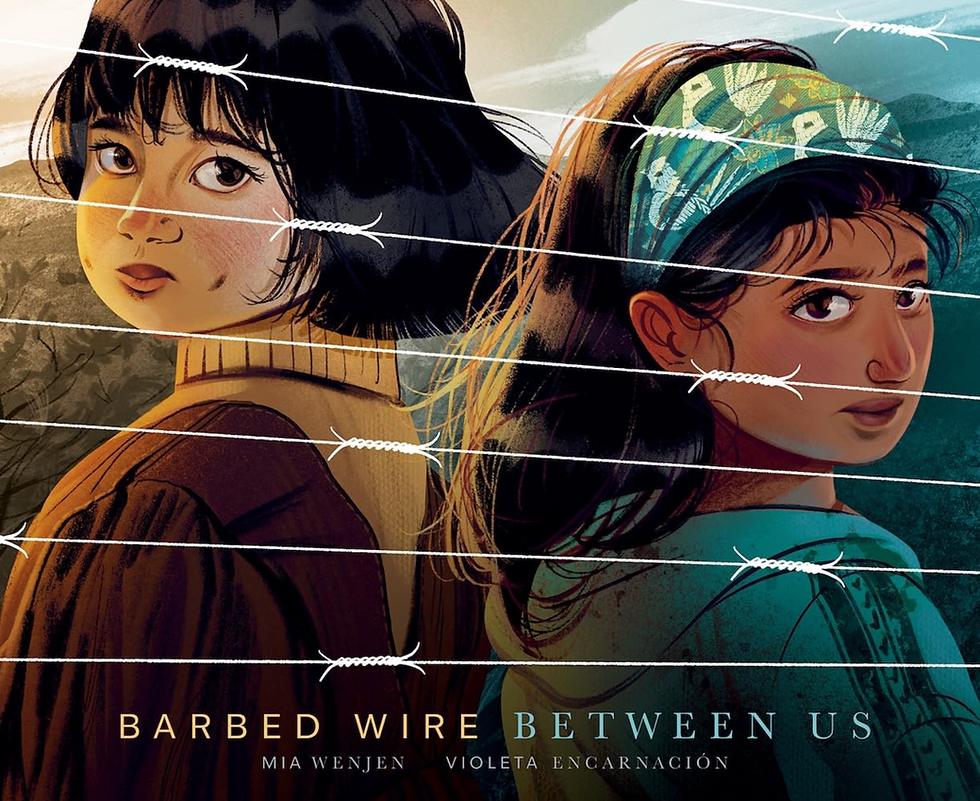
Barbed Wire Between Us
- Jun 19
- 2 min read
A TRUE TALE WITH
A CHERRY ON TOP
Red Comet Press
(pub. 3.11.2026)
48 pages
Ages 7 -11
Author: Mia Wenjen
Illustrator: Violeta Encarnación
Characters: Two girls. Eighty years apart.
One from a Japanese internment camp.
One as a contemporary U.S. migrant.
Overview:
" Barbed Wire Between Us is a powerful reverso poem that tells two deeply resonant stories across time. It begins with a Japanese American girl sent to an internment camp in Oklahoma during World War II. Read in reverse, it reveals the journey of a Latina girl detained in the very same camp decades later, during the U.S. policy of migrant family separation."
Tantalizing taste:
"In this land of promise, we hoped to find a place to belong.
To our surprise, we were unjustly imprisoned.
We came with only what we could carry.
...
To our surprise, we were unjustly imprisoned.
We came with only what we could carry.
In this land of promise, we hoped to find a place to belong."
And something more: The Setting in the Back Matter explains: "Set in Fort Sill, north of Lawton and about eighty-five miles southwest of Oklahoma City, this army base served as one of more than seventy internment camps, housing approximately seven hundred Japanese Americans during World War II.
Starting in 2014, Fort Sill served as an immigrant detention center for children. It is this parallel that serves as the setting for this book."
Mia Wenjen shared in the Author's Note: "My mother was born in San Francisco's Japantown, making her and her siblings US citizens. Her parents emigrated from Hiroshima, Japan. After the Japanese bombed Pearl Harbor on December 7, 1941, Japanese Americans were forced into prison camps known as internment camps. My mother and her family were fortunate. They had relatives living in a remote part of Utah and relocated there. Still, life was hard. For more than four years, they lived in a tent and worked as farm laborers. My mother rarely talked about her years in Utah. I only remember her saying that there were times that her family would joke that they would have been better off at a concentration camp."